
The Sea Empowerment and Research Center (SEREC) has emphasized the urgent need for Nigeria to reposition its freight forwarding profession in line with international standards to enhance national growth and global competitiveness.
Speaking on the issue, Fwdr. Eugene Nweke (Rff), Head of Research at SEREC, stated that aligning the profession with international best practices would not only serve Nigeria’s national interest but also strengthen the country’s standing within the International Federation of Freight Forwarders Associations (FIATA).
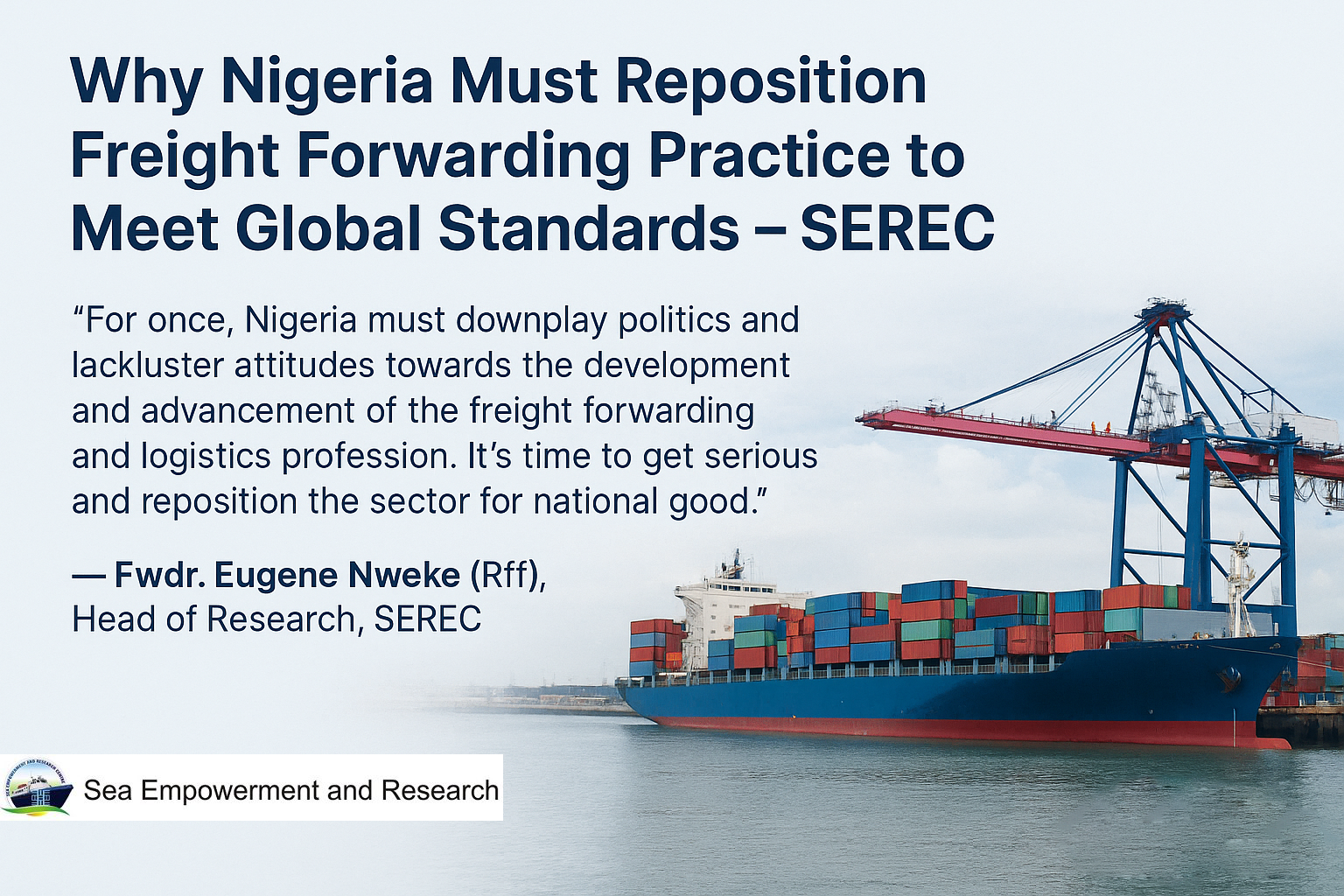
“For once, Nigeria must downplay politics and lackluster attitudes towards the development and advancement of the freight forwarding and logistics profession. It’s time to get serious and reposition the sector for national good,” Nweke urged.
According to him, a stronger and more active participation of Nigeria in FIATA could provide the country with greater influence in shaping global trade policies, as well as positioning it as a leading voice for Africa and the West African sub-region.
Key Benefits of Repositioning the Profession
Nweke outlined several strategic benefits that could result from aligning Nigeria’s freight forwarding sector with global standards:
- Capacity Building & Technical Support: Access to international training, adoption of digital tools, and best practices.
- Partnerships & Funding Opportunities: Enhanced credibility could attract collaboration and investment from global trade and development partners.
- Improved Competitiveness: Nigerian logistics firms could operate more effectively in global markets through better processes and standards.
- Regional Leadership: Nigeria has the potential to become a logistics hub for West Africa through active FIATA engagement.
Regulatory Context
Nweke noted that the Council for the Regulation of Freight Forwarding in Nigeria (CRFFN), established by Act No. 16 of 2007, serves as the principal regulatory body overseeing freight forwarding in Nigeria.
Its mandate includes developing and enforcing professional standards, training practitioners, maintaining a register of licensed freight forwarders, and fostering international collaboration.
However, he observed that while FIATA’s Nigeria country page lists numerous individual member firms, past reports have highlighted institutional challenges — including disputes between CRFFN and other industry associations, as well as concerns about Nigeria’s compliance with FIATA membership obligations.
Institutional Challenges and Risks
Nweke identified key gaps and weaknesses affecting Nigeria’s engagement with FIATA:
- Institutional Friction: Ongoing disputes between CRFFN and some accredited associations undermine sectoral unity and credibility.
- Compliance Issues: Lapses in maintaining FIATA membership requirements — such as dues, reporting, and participation — have previously raised concerns about Nigeria’s standing within the organization.
- Low Representation: Nigeria has rarely held leadership roles within FIATA, limiting its influence on global freight forwarding policy decisions.
The Way Forward
Despite these challenges, Nweke stressed that Nigeria possesses a solid foundation — with a large economy, a vibrant logistics sector, and a legally recognized regulatory body — to achieve global competitiveness in freight forwarding.
He called for renewed collaboration among stakeholders, stronger institutional leadership, and a firm commitment to global best practices to ensure that Nigeria assumes its rightful place in the global freight forwarding community.